Meta Title (SEO)
Sindh Introduces Grading System for Matric & Inter Exams From 2026 | Full Details
Meta Description (SEO)
Sindh government abolishes marks system for matric and intermediate exams, introduces modern grading system from 2026. Check grades, passing criteria, IBCC policy & GPA system details.
Focus Keyword
Sindh grading system for matric and intermediate
Secondary Keywords
- Sindh abolishes marks system
- matric grading system Pakistan
- intermediate exams grading system
- IBCC grading policy
- FBISE grading system 2026
- Sindh education reforms
- GPA system Pakistan boards
URL Slug
sindh-grading-system-matric-intermediate-exams
Introduction: A Major Shift in Sindh’s Education System
The Sindh government has taken a historic step in education reform by officially abolishing the traditional marks-based examination system for matriculation and intermediate levels. Starting from 2026, students across Sindh’s education boards will be assessed under a modern grading framework, aligning provincial standards with national education reforms approved by the Inter Boards Coordination Commission (IBCC).
This landmark decision is being viewed as a transformational move aimed at reducing unhealthy competition, eliminating undue pressure on students, and ensuring uniformity across education boards in Pakistan.
Sindh Government Officially Scraps Marks System
On Tuesday, the Sindh government approved the abolition of numerical marks in board examinations for Secondary School Certificate (SSC) and Higher Secondary School Certificate (HSSC).
Key Announcement Highlights:
- Marks system officially discontinued
- Grade-based evaluation system introduced
- Reform applicable to all Sindh education boards
- Policy implemented in phases starting 2026
The announcement was made by Sindh Universities and Boards Minister Ismail Rahoo, who confirmed that the change is fully aligned with IBCC policy decisions.
Why Sindh Introduced a Grading System
1. Ensuring Nationwide Uniformity
According to the provincial minister, one of the primary objectives of the reform is to create uniform academic standards across Pakistan. Previously, differences in marking practices among boards often resulted in inconsistent merit comparisons, particularly during university admissions.
2. Reducing Exam Pressure on Students
The traditional marks system often leads to:
- Extreme competition
- Memorization-based learning
- Mental stress and anxiety
The grading system shifts focus toward overall academic performance rather than minor mark differences.
3. Aligning With Global Education Standards
Globally, most education systems use grading or GPA-based assessments. By adopting this model, Sindh aims to bring Pakistan’s education system closer to international benchmarks.
IBCC’s Role in the Education Reform
The Inter Boards Coordination Commission (IBCC) plays a central role in policy harmonization across Pakistan’s education boards.
IBCC Approval Timeline:
- August 2025: IBCC formally approved grading framework
- October 2025: FBISE announced revised grading formula
- January 2026: Sindh government issued implementation notification
Sindh’s decision follows IBCC’s directive to standardize examination assessments nationwide.
Phased Implementation of the Grading System
The grading system will be introduced in phases, ensuring smooth adaptation for students, teachers, and institutions.
Implementation Schedule:
- 2026 First Annual Exams
- SSC-I (Class 9)
- HSSC-I (Class 11)
- 2027 First Annual Exams
- SSC-II (Class 10)
- HSSC-II (Class 12)
This phased rollout allows education boards adequate time to update:
- Examination structures
- Result formats
- Teacher training systems
Minimum Passing Criteria Under New System
Under the new grading framework:
- Minimum passing percentage: 40%
- Students scoring below 40% will be declared ‘U’ (Ungraded)
Reappearance Policy:
Students who fail will be allowed to reappear in examinations, subject to existing board regulations and eligibility criteria.
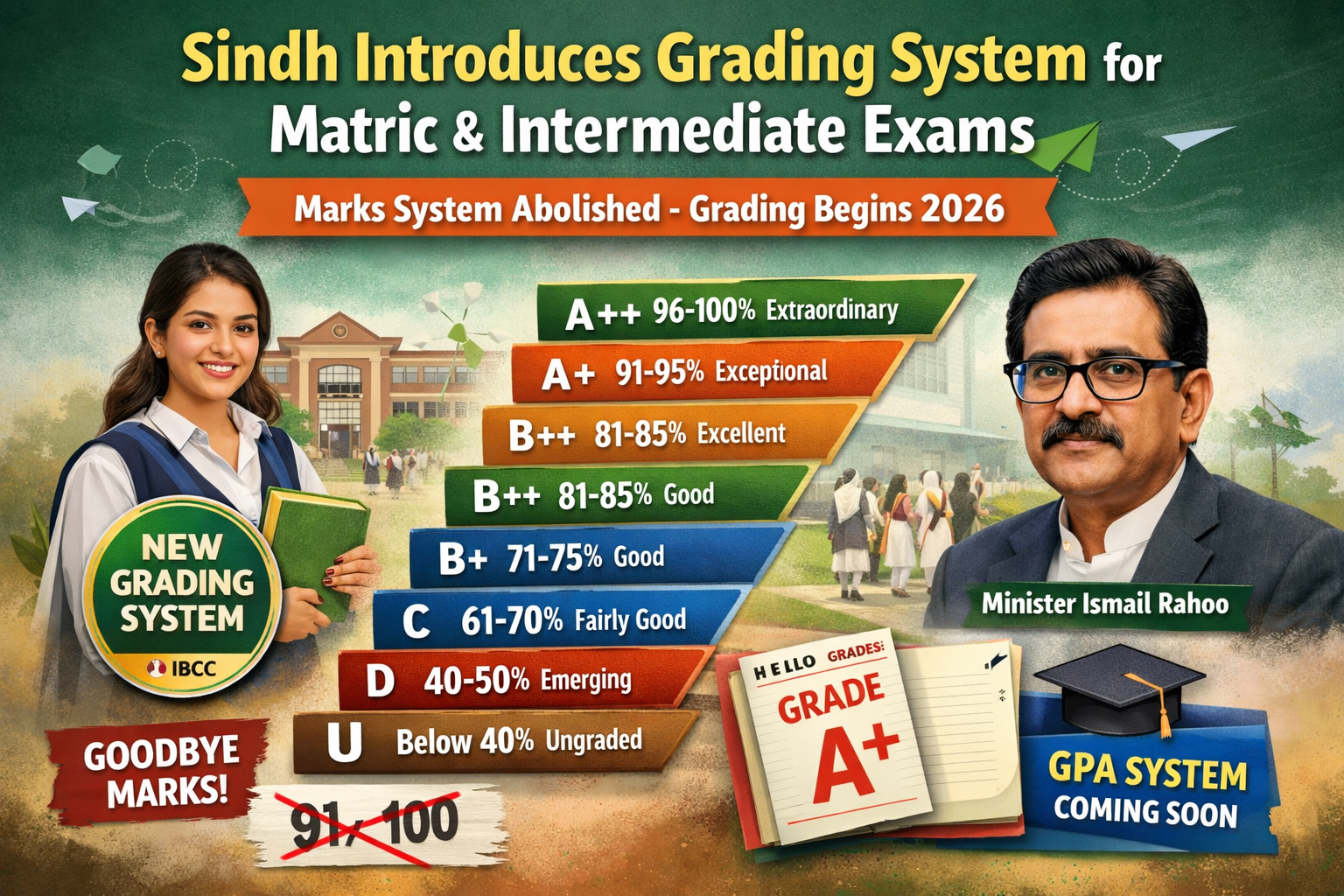
Complete Grading System Explained (SSC & HSSC)
Below is the official grading scale approved by the Federal Board and adopted by Sindh:
Grade Distribution Table
A++ Grade (Extraordinary)
- 96% – 100%
A+ Grade (Exceptional)
- 91% – 95%
A Grade (Outstanding)
- 86% – 90%
B++ Grade (Excellent)
- 81% – 85%
B+ Grade (Very Good)
- 76% – 80%
B Grade (Good)
- 71% – 75%
C+ Grade (Fairly Good)
- 61% – 70%
C Grade (Above Average)
- 51% – 60%
D Grade (Emerging)
- 40% – 50%
U Grade (Ungraded)
- Below 40%
What Happens to the GPA System?
Minister Ismail Rahoo confirmed that a GPA (Grade Point Average) system will be introduced after the grading framework is fully implemented.
Expected Benefits of GPA System:
- Fair university admissions
- International equivalency
- Merit-based scholarship assessments
- Simplified academic comparison
While the exact GPA formula has not yet been announced, education experts believe it will closely follow IBCC and FBISE guidelines.
Impact on Students Across Sindh
Positive Outcomes:
- Reduced stress and exam anxiety
- Focus on learning rather than rote memorization
- Fairer assessment system
- No obsession with single-mark differences
Concerns Raised:
- University admission criteria transition
- Scholarship merit calculations
- Public understanding of grades vs marks
Authorities have assured that awareness campaigns and guidelines will be issued to help students and parents adapt.
Impact on Teachers and Education Boards
Education boards across Sindh will now need to:
- Update result cards
- Train teachers and examiners
- Revise assessment methods
- Align internal evaluations with grading framework
Teachers will also be encouraged to adopt concept-based teaching approaches rather than exam-oriented memorization.
Comparison: Marks System vs Grading System
Marks System (Old)
- High pressure
- Narrow evaluation
- Mark inflation issues
- Unfair inter-board comparisons
Grading System (New)
- Balanced assessment
- Reduced stress
- Uniform national standard
- Modern and globally accepted
Sindh’s Move in National Context
Sindh is not acting alone. Other boards, including FBISE, have already announced similar grading reforms. This signals a nationwide shift toward standardized education assessment.
Education analysts believe Punjab, KP, and Balochistan boards may soon fully align with IBCC grading policies.
What Students Should Do Now
Practical Tips:
- Focus on conceptual understanding
- Don’t panic over marks conversion
- Stay updated with board notifications
- Prepare for grade-based assessments
Parents are advised to guide students away from marks obsession and toward skill development.
Frequently Asked Questions (FAQs)
Will marks completely disappear?
Marks may still be used internally, but result cards will show grades only.
Will universities accept grades?
Yes. Universities are expected to adapt admission policies accordingly.
Is GPA compulsory from 2026?
No. GPA will be introduced after grading system stabilization.
Does this apply to private boards?
All boards affiliated with IBCC are expected to comply.
Conclusion: A Step Toward Modern Education
The introduction of a grading system for matric and intermediate exams in Sindh marks a significant transformation in Pakistan’s education landscape. By moving away from the outdated marks system, the province is laying the foundation for a fairer, stress-free, and internationally aligned assessment model.
While challenges remain during the transition, education experts agree that this reform has the potential to improve learning outcomes and student well-being in the long run.
https://ddersa.xyz/wp-content/uploads/2025/12/ChatGPT-Image-Dec-22-2025-10_28_22-AM-300×200.png
https://ddersa.xyz/wp-content/uploads/2025/12/ChatGPT-Image-Dec-22-2025-10_18_19-AM-300×200.png
About the Author